EMI Research is a top market research consultancy, providing high-quality data to meet client needs. By combining advanced research techniques with deep industry expertise, EMI helps businesses uncover meaningful patterns and opportunities for growth.




EMI was one of the earliest users of Research Defender and had also developed a proprietary suite of fraud solutions; however, this combination was still insufficient in addressing low quality traffic - especially as fraudsters now leverage mobile and residential proxies to hide their IP and location, anti-detect browsers to obfuscate their true device fingerprint, and AI to generate high-quality responses in any language.
Even with Research Defender, EMI noticed post-survey removals had jumped drastically, even hitting 50% on some surveys. As data quality is their key value proposition to clients, they knew they needed an additional security layer.
EMI facilitated a comprehensive bake-off process between Sentry, Research Defender, Dtect and SurValidate.
In EMI’s evaluation process, Verisoul demonstrated an impressive ability to limit false positives. EMI found that Verisoul’s detection isn’t stricter or looser - it’s more precise. Verisoul relies on active forensics vs false-positive prone IP look-ups and “device fingerprints” designed for online advertising attribution. Despite blocking less than half as many respondents, Verisoul outperformed in identifying the respondents most likely to be cleaned out post-survey
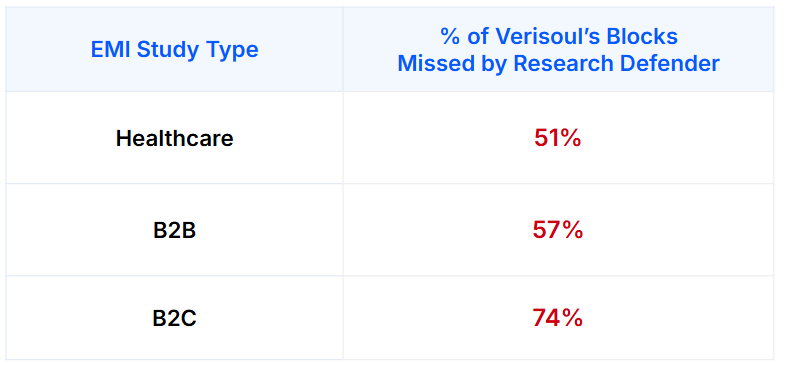
Verisoul agreed much more closely with the accounts Research Defender marked as “Fake.” However, across Healthcare, B2B, and B2C tests, Research Defender missed 51-74% of the fraudsters that Verisoul flagged. Given the augmentative elements of Verisoul’s system, EMI ultimately opted to move forward with a combination of Research Defender and Verisoul. While Verisoul outperforms on network and device signals, EMI retained Research Defender’s pre-dupe functionality that detects hyperactivity and duplicate respondent emails across panels, while leveraging Verisoul for core fraud prevention capabilities.
As a sample consultancy, Verisoul sits at the front of EMI’s workflow (pre-survey), before the respondent ends up in the client’s survey, helping ensure high-quality sample.

Note: This case study intentionally excludes Sentry, given they help catch something unique from the other four providers: low-quality responses from high-quality respondents. Verisoul and Sentry have a bi-directional preferred partnership, and Sentry added a one-click Verisoul integration into their platform.






.jpg)